How to fix cross-functional handoffs in B2B SaaS
Why cross-functional handoffs break in B2B SaaS, why automating them makes it worse, and how process orchestration with AI agents fixes the root cause.

Dhyna Phils
Head of Marketing
Insight
A deal closes. Sales marks it won. Then nothing happens for two days because nobody told implementation. When the implementation team finally picks it up, they don't know about the custom pricing the AE negotiated verbally, or the technical requirement the customer mentioned on the last call, or the fact that the customer's team is going on holiday in three weeks and needs to be live before then.
This is not an edge case. This is Tuesday.
Cross-functional handoffs are the single most expensive operational failure in B2B SaaS companies between 20 and 200 employees. 58% of B2B companies cite process misalignment as their primary growth barrier (Forrester). Uncoordinated handoffs extend deal timelines by 30% and drive acquisition costs up by 36%. For a company doing $5M in ARR, that's potentially $1.8M in excess acquisition cost tracing back to the gap between teams.
And here's the part that most "just add AI" advice misses: if your handoffs are broken, automating them just makes them break faster. The companies winning the AI-native operations race fixed their foundational processes first, then automated.
Where handoffs actually break
The surface-level explanation is "teams don't communicate." The real problem is structural. Handoffs break at specific, predictable points:
The context gap. Sales knows things the next team needs, but there's no structured place for it. It's in Salesforce notes, Slack threads, call recordings, and the AE's memory. The receiving team gets a name and a contract, not the full picture. They spend the first week re-asking questions the customer already answered.
The ownership vacuum. There's a period during every handoff where nobody clearly owns the relationship. Sales considers the deal done. CS hasn't officially started. The customer sends an email during that gap and it sits for four days. HBR found this transition is where B2B companies lose the most customer trust, and it's nearly impossible to recover.
The process fork. Each team has its own workflow in its own tool. Sales in Salesforce, implementation in Jira, CS in something else. The handoff requires manually translating information between systems: re-entry, reformatting, losing details that don't fit the next tool's fields.
The invisible SLA. Nobody defined how long a handoff should take, what information needs to transfer, or what "done" looks like. Sales thinks "handed off" means updating a status field. CS thinks it means a complete brief with technical requirements, timeline, and stakeholder map. Neither is wrong. They just never agreed.
Why more automation makes this worse
The instinct when handoffs break is to automate the gap. Zapier flow on deal close. Slack notification. Auto-generated project in the PM tool.
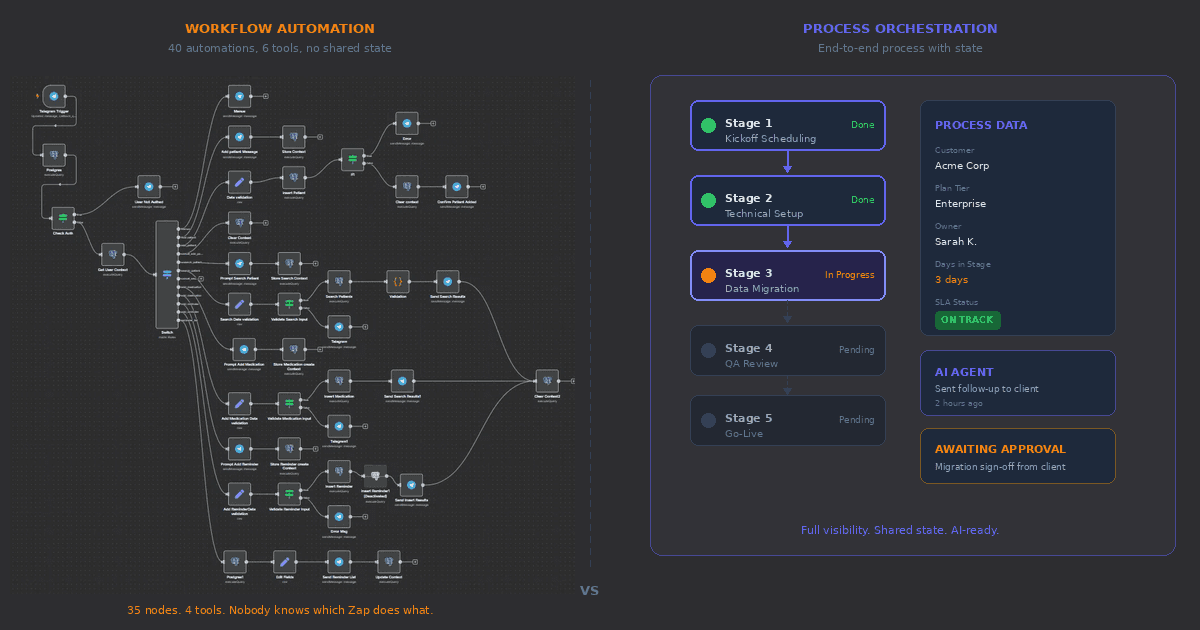
These automations address the symptom (something didn't trigger) without touching the cause (the process is undefined, no system holds the full context). You end up with a Zap that fires on time, creating a task with no context, that the receiving team has to enrich by digging through Salesforce, Gong recordings, and Slack archives. 45 minutes of manual research per handoff.
Stack 15 automations across the handoff boundary and when one fails silently (field formatted wrong, Slack channel renamed), nobody knows until a customer complains. You've built the illusion of a process without the substance of one.
What actually fixes handoffs
The fix isn't automation. It's structure:
A shared system of record for the process, not just the data. Your CRM stores customer data. Your PM tool stores tasks. Neither stores the process: the sequence of stages, who owns what, what triggers the next stage. You need a layer above your individual tools that manages the end-to-end flow.
Structured data that travels with the process. When a customer moves from sales to implementation, the information that matters (plan tier, technical requirements, timeline constraints, key stakeholders, verbal commitments) moves as typed fields attached to the process instance. Not a forwarded email. Not a Salesforce link. Actual data the receiving team sees on day one.
Defined handoff criteria. Each transition has explicit entry and exit conditions. Sales can't hand off until five fields are filled. Implementation can't start until the customer confirms kickoff. CS doesn't take ownership until QA signs off. The system won't let a ticket advance until the current stage is actually complete.
Visibility for everyone, not just the current owner. When a customer is stuck in implementation, the AE should see that without asking. When CS is about to inherit, they should see the full history. Handoffs go from blind tosses to informed transitions.
What this looks like in practice
The moment a deal is marked closed-won, a process kicks off with a defined schema: customer name, plan tier, ARR value, technical requirements, key contacts, AE commitments, go-live target. Sales fills in these fields before the ticket can advance. The system won't let it move without the data.
Once complete, it moves to kickoff scheduling. The onboarding lead sees all structured data without opening Salesforce. An AI agent drafts a kickoff email using the customer's context, account size, and technical details. The lead reviews, adjusts, sends. The process tracks the response, schedules the meeting, advances.
At every point, anyone can see where the customer stands, who owns it, how long it's been in the current stage, and what's blocking it.
The AI-native approach to handoffs
AI helps, but only after the structure is in place. Once you have defined stages, typed data, and clear ownership, agents handle the coordination work:
Draft context summaries for the receiving team
Review whether all handoff criteria are met and flag gaps
Send follow-up emails and status check-ins
Notice a customer stuck in transition for 48 hours and escalate
Monitor SLA compliance across every active handoff
The key: the agent works within a defined process, not as a replacement for one. It can't skip steps. It can't make up field values. The structural decisions (stages, data, approvals) are deterministic and human-defined. The agent executes within those boundaries.
This is the difference between AI that automates your mess and AI that operates within a system designed to prevent the mess.
The cost of waiting
Every month of broken handoffs compounds: longer deal cycles, higher acquisition costs, lost trust in the first week. CS teams spending 30% of their time doing context archaeology.
You don't need a six-month implementation. Modern orchestration tools for the 20-to-200-person B2B SaaS company let you deploy a process template, customize it through conversation with an AI, and have it running in days.
If you're looking for a place to start, Bracket was built for exactly this: process orchestration with AI agents that handle coordination, follow-ups, and status tracking while your team handles the relationships and judgment calls.