What is business process orchestration for B2B SaaS Ops teams
How B2B SaaS ops teams use process orchestration and AI agents to scale operations without scaling headcount.

Dhyna Phils
Head of Marketing
Featured

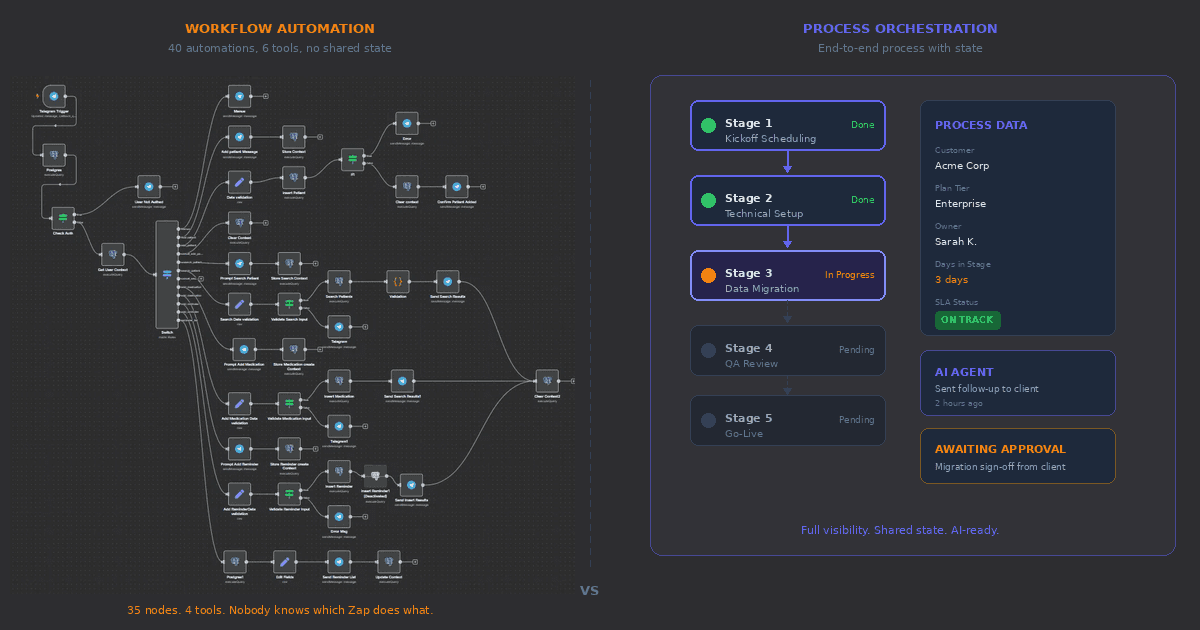
Business process orchestration is the practice of defining, coordinating, and running multi-step business processes across people, systems, and AI agents. It goes beyond automating individual tasks: orchestration manages the full sequence of steps, handoffs, decisions, and exceptions that make up an end-to-end business process like customer onboarding, procurement, vendor management, or internal operations like hiring and compliance.
Most B2B SaaS companies under 200 people run their operations on a combination of project management tools, spreadsheets, Slack channels, and CRM records. The reason this matters now more than ever: ops leaders are increasingly measured on efficiency metrics like revenue per employee, cost per process, and automation rate. The companies pulling ahead aren't the ones hiring more ops people. They're the ones building processes that scale without the headcount, using AI agents to handle coordination while humans handle judgment. That shift is rewriting what "good operations" means in B2B SaaS.
Why ops teams need this
Every repeatable process with multiple steps and multiple owners starts to strain somewhere between 20 and 100 employees, whether it's customer-facing or internal.
What breaks:
Handoffs between teams. A procurement request moves from requester to finance to legal to vendor. A new hire moves from recruiting to HR to IT to their manager. Every handoff is where context gets lost and timelines slip. In customer-facing processes, these gaps are visible. In internal ones, they're invisible, which is worse.
Process consistency. At 5 people, everyone knows how things work. At 30, you need it written down. At 60, you need it enforced. The gap between "we have a process" and "we follow it" grows with every hire, across every department.
Visibility. How many vendor contracts are pending approval? Which new hires are stuck? Where are the bottlenecks? If answering these requires checking five tools and a spreadsheet, you don't have visibility. You have a research project.
Scaling without headcount. If every new customer, hire, or vendor contract requires the same manual coordination, your ops team has to grow at the same rate as your business. That's the math AI-native operations teams are rewriting.
The AI-native operations wave
A new category of company emerged in the last two years that runs fundamentally differently, and the difference shows up in the numbers.
Klarna cut its workforce from around 5,000 to under 3,800 while growing revenue. Their AI assistant handles two-thirds of customer service conversations, doing the work of an estimated 700 agents. Midjourney hit $200M+ in annual revenue with roughly 40 employees. That's north of $5M per person.
The traditional SaaS benchmark was $200K-$300K in revenue per employee. AI-native companies are hitting $500K, $1M, or multiples beyond that.
What's driving this is a structural change in how these companies measure operations. Kyle Poyar at Growth Unhinged captured it well. The KPIs are shifting:
Monthly active users → Token consumption
ARR → Gross profit per token
Product activation → AI quality
Customer health score → Work completed
ARR per FTE → ARR per headcount dollar
Lifetime value → First year value
The shift to "work completed" as a primary KPI is the one that matters most for ops teams. It's a direct measure of output, not a lagging indicator. When your KPI is output, you look hard at every process that creates friction between "task received" and "task done."
The companies making this transition aren't replacing people with AI wholesale. They're splitting work differently:
Agent work: scheduling, status updates, follow-up emails, routing decisions, data entry between systems, negotiation (you'd be surprised)
Human work: relationship building, creative problem-solving, exception handling that requires context
What orchestration looks like in practice
Think of it like a manufacturing line. The process runs on its own, people step in when a decision is needed, and then it moves on without anyone having to manage it.
Customer onboarding. 15-step process, five teams involved, different owners at each stage. Orchestration defines the stages, tracks progress, split the work between humans and agents.
Procurement. Quotes, approvals, POs, delivery tracking. Without orchestration, this lives in email threads and memory. With it, each request moves through defined stages with the right people involved at each one.
Internal ops. Hiring, compliance, contract renewals, incident response. Most of these currently run on Notion pages, Google Sheets, and hope.
Customer feedback. Feedback from Slack, support tickets, sales calls, and emails gets categorized, routed, prioritized, and tracked through resolution.
Building blocks of a process orchestration system
What separates real orchestration from a dressed-up task list:
Structured data per process. Typed fields (vendor, budget, delivery date) attached to each process type. Not free-text descriptions. Not chat messages. Real data you can filter, sort, and report on.
Defined stages. "In progress" is not a stage. "Waiting for vendor quote" is. Clear criteria for when a ticket moves from one stage to the next.
Configurable autonomy per step. Send the outreach email automatically, but have a person review the quote. The ability to dial automation up or down per step is what separates a useful system from one that's too rigid or too loose.
Human-in-the-loop where it matters. Large purchase needs approval. Customer environment needs QA. The system knows which steps need human sign-off and which can proceed automatically.
Communication channel integration. Messages from Slack, email, and chat pulled into the process context. Reply from the same place. No more "another tab to keep open."
How AI changes this
Traditional BPM tools required mapping every possible path and exception. Brittle, expensive, only worked for predictable processes.
AI handles the unpredictable parts: drafting follow-ups that account for a vendor's specific response, evaluating whether a support ticket is a blocker or a minor question, deciding if a quote is within range. Judgment calls that used to require a human every time.
The design problem is figuring out which parts should be deterministic and which should be left to AI reasoning. The answer is a mix:
Deterministic: stage transitions, data updates, routing, permission checks
AI reasoning: content generation, interpretation, prioritization, judgment calls
Most current tools get this wrong. They're either fully manual (AI is a chatbot you ask questions) or fully automated (AI runs everything, you hope for the best). The middle ground, where specific steps are locked down while others are open to AI reasoning, is where the real value sits. An agent that drafts vendor outreach on its own but can't skip the approval step for a purchase over $10K.
When to invest
Quick test: can your team answer "where is customer X in onboarding?" in under 10 seconds from one screen? If not, you probably need orchestration.
Other signs: scaling headcount as the process volume grows, Ops spends more time coordinating than doing. New hires take months to learn how things work. Customers fall through cracks between stages. You've tried to standardize a process three times and it keeps drifting.
Two years ago, this meant a six-month enterprise BPM implementation. Today, tools built for 20-to-100-person B2B SaaS companies let you deploy a process template, customize it through conversation with an AI, and have it running in a day. The barrier dropped. The cost of waiting went up.
The companies that will define the next era of B2B SaaS aren't the ones with the biggest teams. They're the ones that built processes that scale without the headcount.
If you're looking for a place to start, Bracket was built for exactly this: process orchestration with AI agents that handle coordination while your team handles the decisions.