Why your AI automation isn't working (and what to fix first)
Why 80% of companies using AI see only 40% business impact, and how an orchestration layer with structured data and process ownership fixes it.

Yann Paul
HR Manager
Insight
About 80% of companies report using generative AI in at least one business function. Only about 40% report any enterprise-level business impact. That gap is not a technology problem. It's a process problem.
2025 was the year every team ran their own AI experiments in isolation. Marketing tested content generation tools. Sales piloted AI SDRs. CS tried automated health scoring. Finance explored AI-assisted forecasting. Each team picked a tool, ran a pilot, and declared partial success. But the experiments stayed siloed, and the results stayed small, because none of these tools were working on top of a shared operational foundation. They were working on top of spreadsheets, Slack threads, and ad hoc workflows that were already broken before AI entered the picture.
2026 is the year someone has to make these agents actually work together. And the companies that figure that out first are the ones that will pull away on revenue per employee, cost per process, and every other efficiency metric that boards are now watching closely.
The pattern: AI works in demos, fails in production
If you've deployed AI agents or automation in your ops workflows and the results have been underwhelming, you're probably seeing one of these patterns:
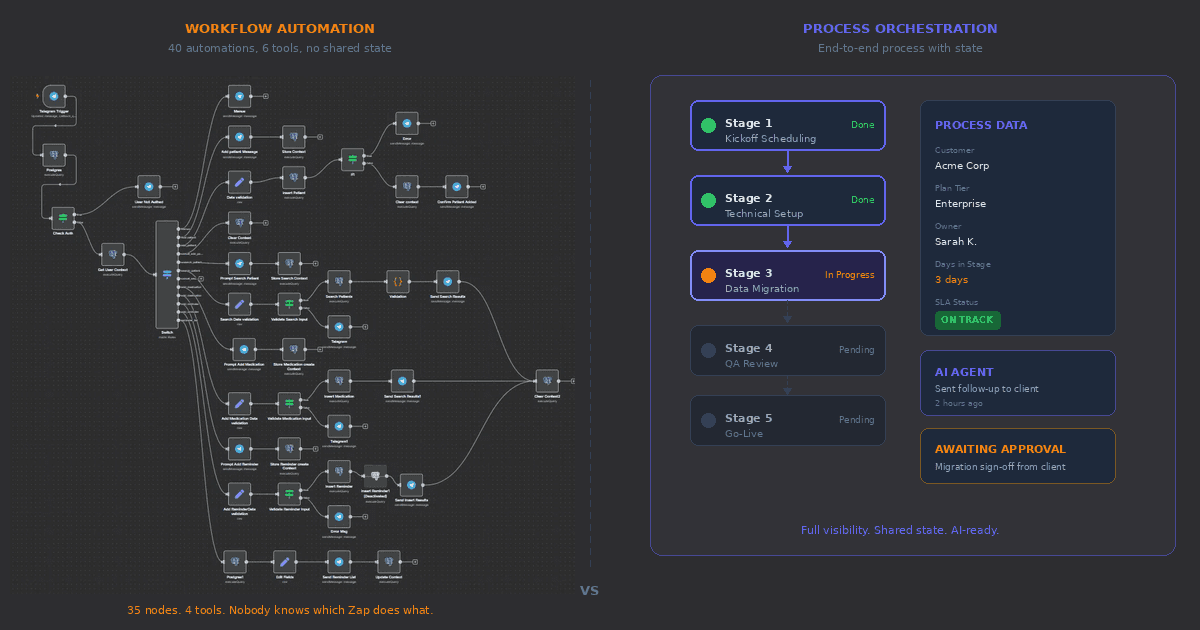
The automation fires correctly but creates downstream chaos. A Zap triggers on deal close and creates an onboarding task, but the task has no structured data, no assigned owner for the next stage, and no connection to the customer's actual requirements. Someone has to manually reconstruct the context.
AI handles one step well but the surrounding process is manual. An agent can evaluate vendor quotes accurately, but the steps before it (collecting quotes in a structured format) and after it (routing the recommendation to the right approver) are still happening in email threads and Slack.
Different teams have different AI tools that don't talk to each other. Sales uses an AI SDR that books meetings, but the context from those meetings doesn't flow into the onboarding process that CS runs in a completely separate tool.
The common thread: the AI is fine. The process it's operating in is the problem.
Why process is the bottleneck, not AI capability
AI agents are good at a specific set of things: generating content, interpreting unstructured information, making judgment calls based on context, and executing tasks within defined parameters. What they're bad at: inventing process structure, maintaining state across multiple steps, enforcing handoff criteria, and knowing when to stop and ask a human.
When you deploy an AI agent into an undefined process, you're asking it to do the thing it's worst at. You're asking it to figure out what should happen next, who should be involved, what data matters, and when to escalate. The agent will produce something, but it won't be reliable, consistent, auditable, or repeatable. Every run will be slightly different. Some will miss steps. Others will hallucinate actions that were never part of the intended workflow.
This is why 80% adoption produces 40% impact. The AI is deployed. It runs. It generates output. But without process structure underneath it, the output doesn't connect to anything. It doesn't advance a defined workflow. It doesn't update structured data. It doesn't trigger the next step. It just produces artifacts that a human then has to manually route, review, and act on, which defeats the purpose.
What AI actually needs to work
Before an AI agent can deliver real operational value, four things need to be in place:
Structured data, not free text. An agent that processes a vendor quote needs typed fields: vendor name, quote amount, delivery timeline, payment terms. If the input is a forwarded email or a Slack message, the agent has to interpret and extract before it can act, which introduces errors. Typed, validated data as input means the agent starts from clean information.
Defined stages with clear transitions. The agent needs to know where in the process it's operating, what the expected output of this stage is, and what triggers the next stage. Without this, it's guessing. With it, the agent can execute its specific task and hand off to the next step automatically.
Configurable autonomy per step. Some steps should be fully automated (agent sends the follow-up, no human review). Others should be agent-assisted (agent drafts, human reviews and sends). Others should be human-only (final approval on a purchase over a threshold). The system needs to define this per step so the agent knows its boundaries.
Human-in-the-loop gates. Certain decisions need a person. A customer escalation. A contract above a certain value. An exception that doesn't fit the standard process. The AI needs to know when to stop, surface the decision to the right person with the right context, and wait. Without defined HITL gates, agents either over-automate (making decisions they shouldn't) or under-automate (flagging everything for review, creating more work than they save).
None of these are AI problems. They're process orchestration problems. And they need to be solved before AI can deliver on its promise.
The orchestration layer
This is what separates companies getting real value from AI and companies still running pilots.
The companies that work have an orchestration layer: a system that defines their processes as structured sequences of stages with typed data, clear ownership, configurable automation levels, and human-in-the-loop checkpoints. AI agents operate within this layer. They have defined roles, defined inputs, defined outputs, and defined boundaries. They advance work through a process. They don't invent the process.
Think of it like hiring. You wouldn't hire a new employee, give them no role description, no reporting structure, no defined responsibilities, and expect them to figure out what to do. But that's exactly what most companies do with AI agents. They deploy the capability without the structure.
The companies reporting real business impact from AI have:
Processes defined as stages with typed properties, not as wiki pages or Slack threads
Each stage owned by a person or an agent with clear entry and exit criteria
AI agents assigned to specific steps with defined autonomy (fully autonomous, supervised, or advisory)
Handoff rules that prevent work from advancing until the current stage is actually complete
Visibility across the full pipeline so humans can see what agents are doing and intervene when needed
BizOps as the AI integration layer
There's a reason BizOps leaders are increasingly positioned as "AI integrators" within their organizations. The challenge isn't picking the right AI tool. It's building the operational foundation that makes any AI tool useful.
This means: defining cross-functional processes with enough structure that agents can operate reliably. Cleaning up the data layer so AI inputs are typed and validated, not scraped from email threads. Setting up HITL gates at the right points so AI has room to execute while humans retain control over decisions that matter. And creating visibility so leadership can see whether AI is actually producing business outcomes, not just producing output.
This is operational work, not engineering work. It's the kind of work that BizOps teams are built for. And it's the work that determines whether your AI investment produces the 40% impact or the 80% impact.
What to do about it
If your AI automations aren't delivering, resist the urge to try a different AI tool. The tool probably isn't the problem. Instead:
Pick your highest-volume process (customer onboarding, procurement, or whatever runs most frequently)
Define it as actual stages with typed data fields, not as a description in a document
Assign ownership per stage, with clear criteria for when work can advance
Decide per step: what should be fully automated, what should be agent-assisted, and what needs a human
Deploy AI agents within that structure, not on top of the existing mess
The gap between "we use AI" and "AI is producing business impact" is almost always a process gap. Close that gap first, and the AI starts working.
Bracket was built for this: the orchestration layer that gives AI agents structured processes, typed data, and clear boundaries so they actually deliver results instead of producing output nobody acts on.